How a Summerhouse Balcony Helps Count Right Whales This Winter
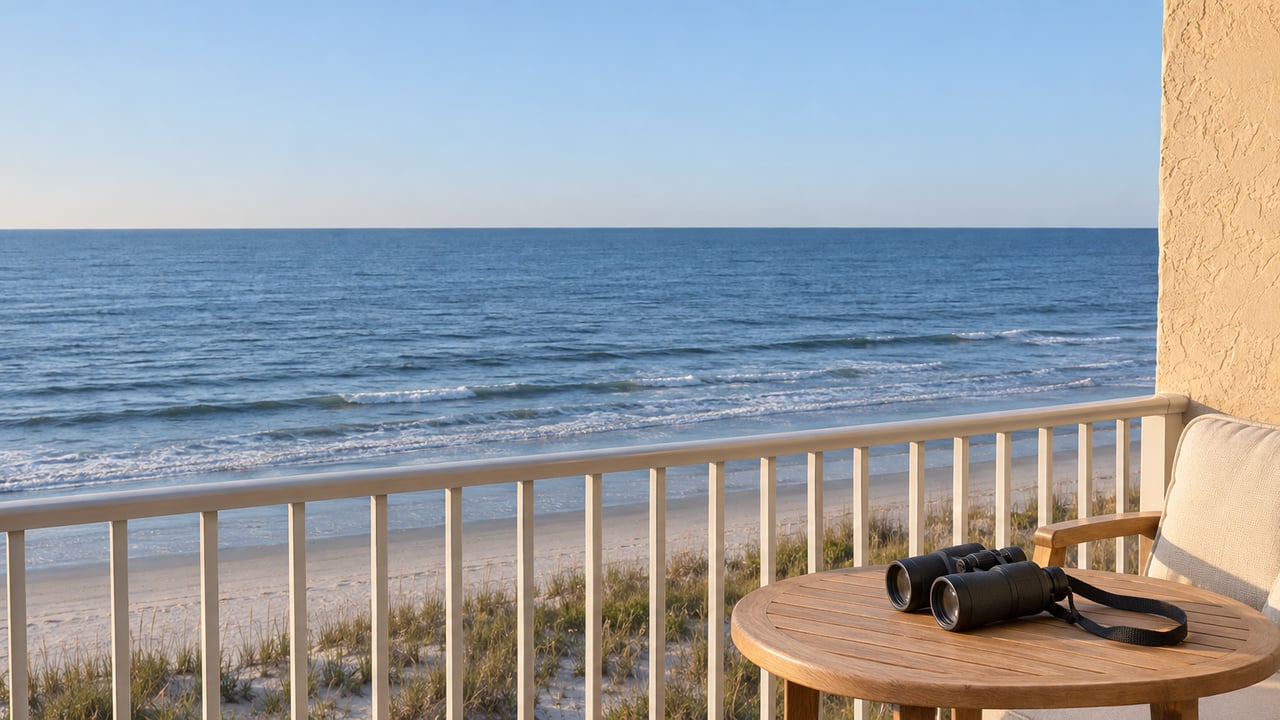
Around 11 a.m. on March 5, a volunteer named John G. was looking at the ocean from Summerhouse Beach & Racquet Club when he spotted Juno, catalog #1612, and her calf. He was on the Marineland Right Whale Project's stationary survey team. The pair moved south and turned up near Marineland that afternoon. Just after 6 p.m., stationary survey team leader Tom G. reported them again off the Surf Club Condominiums. Drone footage showed the calf was female.
Last winter, the stretch of A1A from Crescent Beach down to Matanzas Inlet was one of the places this endangered species was seen and identified, and some of those sightings came from people watching out of the condo buildings. The 2026-27 season has already started. Its first mother has a history with whales last seen off Summerhouse.
The Marineland Right Whale Project sightings log for March 2026 reads like a guide to this part of Anastasia Island.
On Monday, March 2, two adult females, Calamari, #3946, and Babushka, #3890, were spotted just north of Matanzas Inlet near the Summerhouse condos. The two had traveled together all season. Dr. Jim Hain, quoted on the project's log, described how that day felt: "It seemed quiet. Were the whales gone? Were we ready to give up? No. Whales popped up. Yahoo!" By that date the project had counted eight mother-calf pairs, two yearlings and a group of right whales in its survey area for the season.
Juno and her calf came three days later, with the first sighting from Summerhouse.
The March 14 sighting is the clearest example of how this network operates. A beach walker and her husband called the Right Whale Hotline. At 10:05 a.m., Blue World Research Institute, which runs the hotline, called the project to say a whale was heading south near Ocean Hammock Park. By 11:07 a.m., spotters had moved south and filmed from Ocean Trace Road in Crescent Beach. At 12:08 p.m., a spotter found the whales off Butler Beach. A Florida Fish and Wildlife Conservation Commission plane responded and identified the mother as Mirror, #4617, with a calf. That calf was the 23rd of the season. Later that day the pair passed Marineland at 5:05 p.m., the Surf Club at 6:50 p.m. and Bay Street in Palm Coast at 7:09 p.m. NOAA Fisheries chose an aerial photo from that day, showing Mirror and her calf "just beyond the surf in Crescent Beach," to illustrate its end-of-season report.
NOAA recorded 23 calves in its 2026 calving season, which ended in the spring, the most in any season since 2009. Twenty of the mothers had calved before. Thirteen of those had last given birth in the 2021 or 2022 season, which NOAA notes is a shorter gap than the recent average of 7 to 10 years. Across the Southeast that season, NOAA counted about 500 sightings of 129 individual right whales. The sightings came from aerial and vessel surveys, members of the public, the volunteer sighting network, military vessels and dredging operations.
Those numbers look different next to the size of the population. NOAA estimates about 380 right whales remain, and only about 70 of them are reproductively active females. Mirror was 10 years old, and this was her first calf. FWC had last seen her on Feb. 12 without a calf, which meant the calf off Crescent Beach was only a few weeks old. The 23rd calf of the record season entered the count because someone on a beach walk saw something and called it in.
The 2026-27 season began within a week of NOAA's mid-November start. On Nov. 10, 2026, members of the public reported a mother and calf to the NOAA hotline about 11 nautical miles east of St. Augustine Inlet. Scientists identified the mother as Curlew, #4190. She is 16, this is her first calf, and she is named for a scar on her back shaped like a curlew's curved bill. NOAA's 2027 season page listed her as the only calf identified as of its Nov. 13 update. Updates come as new pairs are identified.
Curlew's earlier travels are unusual. In the 2025 season she and another female, Koala, left the Southeast calving grounds and went through the Gulf to Alabama, the Florida Panhandle and southwest Florida, then to the Bahamas. NOAA calls that last stop a first for the species. In 2022, according to the Marineland Right Whale Project, she traveled with Babushka, the same female seen near the Summerhouse condos with Calamari last March 2.
The project's right whale identification page gives a short list of what to look for. The back is smooth and has no dorsal fin. The blow is V-shaped. The head has rough patches called callosities. The whale is dark and has broad black flippers.
The project's volunteer handbook describes how its teams watch. Mobile teams start at 8 a.m. and check a series of lookout points twice. Condo teams watch from the upper floors of shorefront buildings. Calm water helps too. On Feb. 18 the project noted that rough weather earlier that week had kept its drone on the ground, and calmer seas finally let pilot Jeff Greene film Squilla, #3720, and her calf.
The close-up drone footage the project posts is flown under a federal research permit, NMFS Permit #26562, and the permit number appears on each photo credit. From a balcony, the useful tools are binoculars and a phone with a zoom lens.
The Marineland Right Whale Project asks people to report whales they are watching to the Right Whale Hotline at 1-888-97-WHALE, which is 888-979-4253. That is the line the beach walker called on March 14. NOAA has its own sighting line for North Carolina through Florida at 877-942-5343, and it also takes reports through the Whale Alert app or U.S. Coast Guard channel 16.
NOAA asks for the date, time, location, a description, your contact information, and photos or video if you have them. Last March, giving a cross street or a building name was enough. Ocean Hammock Park, Ocean Trace Road and Summerhouse each gave the next spotter a place to start.
The project's survey area covers about 70 nautical miles of coast, from Ponte Vedra Beach to Ponce Inlet. The project says mother-calf pairs use Florida's shores from December through March. It offers three ways to take part. Mobile survey teams search from designated lookout points and ask for at least one morning a week. Casual observers keep watch when they can and call the hotline. Stationary teams are made up of residents of an oceanside condo or community who survey together from their own building. If a community has no stationary team yet, its residents may be able to start one. The Juno and Mirror sightings show what the stationary approach can do on this stretch, from Summerhouse north toward St. Augustine Beach.
The project has published its 2027 schedule. Here are the dates:
| Date | Event |
|---|---|
| Sunday, Jan. 3, 2027 | Beginning-of-season meeting |
| Monday, Jan. 4, 2027 | First surveys |
| Saturday, Feb. 6, 2027 | Mid-season meeting |
| Saturday, March 13, 2027 | Last surveys |
| Sunday, March 21, 2027 | End-of-season meeting |
The volunteer application is on the project's website, which says it always needs seasonal volunteers. Formal surveys don't start until January, but the season does not wait for them. Curlew and her calf were reported on Nov. 10, and the hotline answers calls now.
At Lighthouse Realty, our family-run office sits at 5401 A1A South, and this stretch of beach is home to us too. If you see a smooth dark back with no fin off Crescent Beach this winter, call the hotline first. When you want to talk about life on the south end of Anastasia Island, contact us. We're available seven days a week.
Lighthouse Realty has been in business in the St. Augustine area for over 30 years. We are open 7 days a week to provide you with the best real estate service in St Augustine.