Palm Coast Canal Home Buyer Due Diligence: What to Confirm Before an Offer
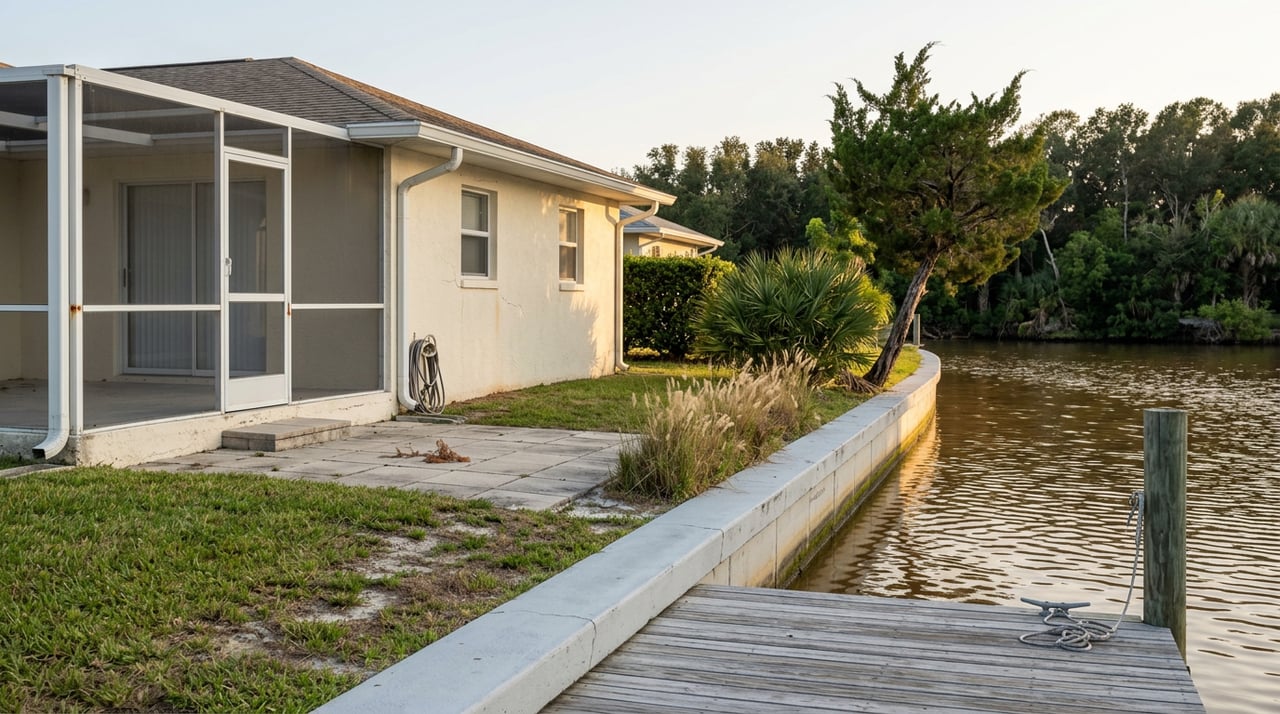
How deep is the water at your dock when the tide goes out? Most people touring a canal-front listing in Palm Coast never ask that question. They ask about the dock, the lift, the view from the lanai, whether the seawall looks solid. Those are fair questions. They are also not the one that actually determines whether you can use the water the way you're picturing.
Palm Coast's saltwater canal network has never been dredged since it was dug. Not once, in more than fifty years. That single fact, confirmed by the city's own engineers, is the piece of information that separates a canal home that delivers on its promise from one that quietly can't.
The canals are the reason Palm Coast exists in its current form. Around 1970, ITT Levitt Development Corporation brought prospective buyers out by boat to view homesites, ferrying them from a small dock near the Intracoastal Waterway to look at land that didn't have a house on it yet, only the promise of water access. The pitch worked. Buyers paid a premium for a lot that touched saltwater, and that premium has held for five decades.
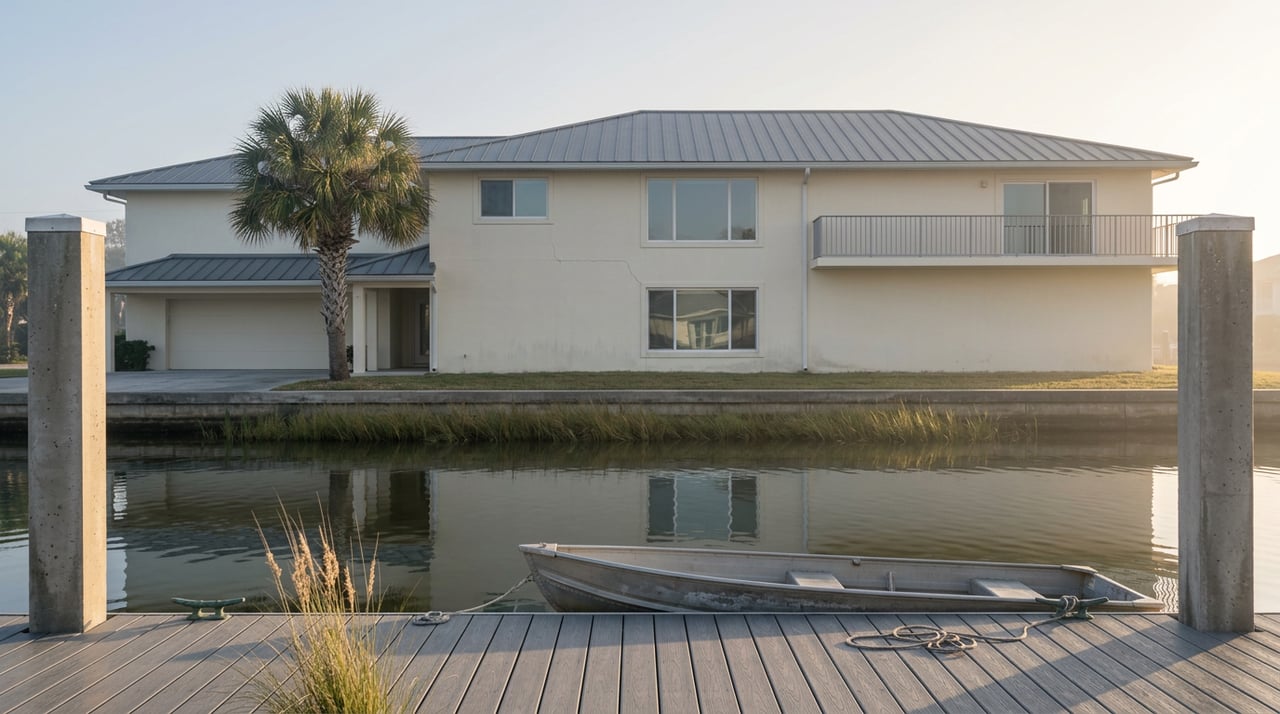
Today the canal system covers 26 miles, concentrated almost entirely in Palm Coast's C-Section and a portion of the F-Section, the area most people know as Palm Harbor. More than 2,500 homes back up to these canals. Some sit on segments with no fixed bridges between the house and the Intracoastal, a stretch locals still call Sailboat Country because a sailboat's mast can clear the whole run without a bridge in the way. Other homes sit behind one or more bridges, which caps what kind of boat can realistically live at that dock regardless of what the water depth allows.
That distinction, bridged or unbridged, has always mattered to boat owners. What's changed recently is that a second distinction now matters just as much: whether your specific stretch of canal still holds the depth it was built with.
In 2023, Palm Coast hired Taylor Engineering to run a bathymetric survey, essentially a depth map, of the entire canal system. The results explained a complaint the city had been hearing for years from residents who said their boats sat stuck at low tide.
The main entrance canals, the wider channels that connect neighborhoods to the Intracoastal, were built to roughly 13 feet and still measure close to 8 feet today. The residential canals that branch off them, the ones that actually run behind most backyards, were built to roughly 9 feet. The survey found about 13 of the system's 26 miles now sitting under 6 feet at the centerline, with some of the narrower residential fingers measuring as shallow as 2 feet.
A centerline reading is not the same as the depth at your dock. Sediment builds unevenly, and a canal can read 6 feet in the middle while running a foot shallower along the banks where boats actually tie up.
As ClickOrlando reported, one resident said during public comment at a 2025 council meeting: "My neighbors, many of them, can't even get their boats off their docks."
It's the plainest way to state what a shallow reading actually costs a homeowner. It's not an aesthetic problem. It's the difference between owning a boat and owning a boat you can't launch.
Knowing the water is shallow is one thing. Knowing who fixes it, and when, is the part that actually affects a purchase decision.
As of the most recent city budget, Palm Coast has set aside $500,000 for a saltwater canal dredging initiative for the fiscal year now underway. That figure covers planning and early groundwork, not a completed project. Engineering estimates for the dredging itself have ranged from roughly $1 million for the most limited, spot-dredging approach up to $10 million or more to bring the shallowest sections back toward their original depth, and those estimates don't even include the cost of dredging the entrance channels or the 20 feet of canal closest to each property line, the area engineers have identified as the individual owner's zone rather than the city's.
The council has been weighing at least two competing scopes. One councilmember has favored the cheaper option as the only one the city can realistically afford right now, even while acknowledging it still costs real money that has to come from somewhere in the budget. The vice mayor has pushed for the more thorough option, arguing a half-measure now just means paying twice later. Neither option has secured a funding source. Grant money, the kind that typically pays for this sort of infrastructure work elsewhere in Florida, mostly requires public access and public benefit, and Palm Coast's canals are almost entirely private, dead-end waterways serving private docks. As Observer Local reported, the city's stormwater engineer said during a presentation that the canals are "a little bit too good to qualify for some of these grants."
That leaves canal-front property owners as the most likely funding source, whether through a special assessment tied to specific parcels or a broader citywide fee. The vice mayor has also pointed out publicly that canal-front homes already pay close to double the property tax of a comparable non-canal home in Palm Coast, which is part of why the question of who pays for dredging has become genuinely contested at the council table rather than a formality.
None of this means a Palm Coast canal home is a bad idea. It means the due diligence looks different than a generic waterfront checklist would suggest. Before you write an offer on a canal-front property here, confirm the following:
The pitch ITT Levitt made in 1970 is still true in the broad sense. Saltwater access from your own backyard is a genuine amenity, and it's part of why these parcels command what they do. What that pitch didn't include, because it didn't need to at the time, was what fifty years of undredged canal bottom would eventually mean for the buyer standing at the dock deciding whether their boat will actually float free at 6 a.m.
That's the number worth asking about before you fall for the photos. Not whether the home has water access, but whether the water at that specific dock still does what the listing implies.
If you're comparing canal-front sections in Palm Coast, whether that's a bridge-restricted stretch off Colechester Lane or an open run in Sailboat Country, Lighthouse Realty can walk the specific segment with you, help you line up a depth check before you write an offer, and talk through what the current dredging debate might mean for your section. Contact us, and let's look at the actual water, not just the view of it.
This article is general information, not legal, tax or financial advice. Consult a qualified professional about your situation.

Lighthouse Realty has been in business in the St. Augustine area for over 30 years. We are open 7 days a week to provide you with the best real estate service in St Augustine.